Task Composer
The Task Composer orchestrates complex planning pipelines by chaining planners (OMPL, TrajOpt, Descartes), collision checks, and time parameterization into a dataflow graph. The high-level TaskComposer wrapper lives in tesseract_robotics.planning.
Overview
graph TD
    A[Input Program] --> B[MinLengthTask]
    B --> C{Freespace?}
    C -->|Yes| D[OMPLTask]
    C -->|No| E[DescartesTask]
    D --> F[TrajOptTask]
    E --> F
    F --> G[TimeParameterizationTask]
    G --> H[ContactCheckTask]
    H --> I[Output Trajectory]
Basic Usage
import numpy as np
from tesseract_robotics.planning import (
    CartesianTarget, JointTarget, MotionProgram, Pose, Robot, TaskComposer,
)

robot = Robot.from_tesseract_support("abb_irb2400")

program = (
    MotionProgram("manipulator", tcp_frame="tool0", working_frame="base_link")
    .move_to(JointTarget(np.zeros(6)))
    .move_to(CartesianTarget(Pose.from_xyz_rpy(0.6, 0.0, 0.5, 0, 0, 0)))
)

composer = TaskComposer.from_config()
result = composer.plan(robot, program, pipeline="TrajOptPipeline")

if result.successful:
    print(f"Planned {len(result.trajectory)} waypoints")
    for state in result.trajectory:
        print(state.positions)
else:
    print(f"Planning failed: {result.message}")
from tesseract_robotics.tesseract_common import GeneralResourceLocator
from tesseract_robotics.tesseract_task_composer import (
    AnyPoly_wrap_CompositeInstruction,
    AnyPoly_wrap_EnvironmentConst,
    AnyPoly_wrap_ProfileDictionary,
    TaskComposerDataStorage,
    TaskComposerPluginFactory,
)

locator = GeneralResourceLocator()  # any ResourceLocator, including a Python subclass
# str = config *path* here; unlike Environment.init, this factory has no content overload bound yet
factory = TaskComposerPluginFactory(str(config_path), locator)

# Executor + pipeline node
executor = factory.createTaskComposerExecutor("TaskflowExecutor")
pipeline = factory.createTaskComposerNode("TrajOptPipeline")

# AnyPoly-wrap the inputs the pipeline expects
storage = TaskComposerDataStorage()
storage.setData("planning_input", AnyPoly_wrap_CompositeInstruction(composite))
storage.setData("environment",    AnyPoly_wrap_EnvironmentConst(env))
storage.setData("profiles",       AnyPoly_wrap_ProfileDictionary(profiles))

# Execute
future = executor.run(pipeline, storage)
future.wait()

output_key = pipeline.getOutputKeys().get("program")
output = future.context.data_storage.getData(output_key)
Prefer the wrapper
TaskComposer hides all the AnyPoly wrapping, input/output key discovery,
profile selection and trajectory extraction. Drop to the low-level API
only when you need to assemble a custom task graph at runtime.
Plugin Warmup
First plan() call is slow (~10-15 s)
The Task Composer uses dynamic plugin loading (boost_plugin_loader /
dlopen). The first call to createTaskComposerNode(...) loads the
shared library for TrajOpt, OMPL, Descartes, etc. Subsequent calls in
the same process are instant (plugins cached in memory). This is
inherent to the plugin architecture — the same behaviour is observed in
the C++ TaskComposer.
TaskComposer.warmup(...) amortizes that cost up front. See
planning/composer.py for the full docstring.
from tesseract_robotics.planning import TaskComposer

# Option 1: explicit warmup — clearest timing profile
composer = TaskComposer.from_config()
composer.warmup(["FreespacePipeline"])          # ~10-15 s
result = composer.plan(robot, program, pipeline="FreespacePipeline")  # fast

# Option 2: warmup=True — loads a curated set of common pipelines
composer = TaskComposer.from_config(warmup=True)

# Option 3: warmup=[...] — specific pipelines only
composer = TaskComposer.from_config(
    warmup=["TrajOptPipeline", "OMPLPipeline"],
)
When warmup helps:
- Interactive use (REPL, Jupyter) — pay once, plan many times.
- GUI / service applications — initialize at startup, fast responses after.
- Benchmarking — separate plugin-load time from algorithm time.
When warmup doesn't help:
- Single-run scripts — total wall-clock time is roughly the same either way.
Available Pipelines
TaskComposer.get_available_pipelines() takes the configured node names from the factory (TaskComposerPluginFactory.getTaskComposerNodePlugins()), builds each one once, and returns those that built. The config is read as the C++ factory loaded it, so !include works, and a TaskComposer built from a factory without config_path lists its pipelines too. As of the current task_composer_plugins.yaml this is 36 pipelines:
composer = TaskComposer.from_config()
pipelines = composer.get_available_pipelines()
print(pipelines)
A representative sample:
| Pipeline | What it runs |
|---|---|
FreespacePipeline |
OMPL → TrajOpt → time parameterization |
CartesianPipeline |
Cartesian path with TrajOpt |
TrajOptPipeline |
TrajOpt optimization only |
OMPLPipeline |
OMPL sampling only |
RasterFtPipeline |
Industrial raster with freespace transitions |
DescartesFPipeline |
Descartes forward graph search |
See TaskComposer.get_available_pipelines() at runtime for the full 36.
Pipeline count is not a contract
The exact number is driven by task_composer_plugins.yaml in the
packaged tesseract_task_composer data. It may grow or shrink in
future versions. Treat get_available_pipelines() as the source of
truth, not the literal "36".
Splitting a config with !include
The factory expands !include when it loads a config from a path. A relative
path resolves against the including file's directory:
# main.yaml
task_composer_plugins:
  search_paths: [...]
  search_libraries: [...]
  executors: {...}
  tasks: !include tasks.yaml
TaskComposer.from_config("main.yaml") and get_available_pipelines() see the
included tasks. To inspect the config the factory loaded:
factory = composer.factory
factory.getTaskComposerNodePlugins()           # {node name: PluginInfo}
factory.getAvailableTaskComposerNodePlugins()  # node factory class names
The two differ: getTaskComposerNodePlugins() is keyed by the names you pass
to plan(pipeline=...) (TrajOptPipeline), while
getAvailableTaskComposerNodePlugins() lists the factory classes the plugin
libraries export (PipelineTaskFactory), the values a PluginInfo.class_name
may take. The second call loads the plugin libraries.
Convenience methods
TaskComposer also exposes per-backend shortcuts:
composer.plan_freespace(robot, program)   # TrajOptPipeline
composer.plan_ompl(robot, program)        # OMPLPipeline
composer.plan_cartesian(robot, program)   # DescartesDPipeline
Or use the module-level functions from tesseract_robotics.planning:
from tesseract_robotics.planning import plan_freespace, plan_ompl, plan_cartesian

result = plan_freespace(robot, program)
Without a composer, each module-level call builds a new composer and loads the task composer
plugins again, about 4.3 s on macOS arm64, so timing a solve through it measures the load.
Build one composer and pass it to every call; you own its lifetime (#137):
from tesseract_robotics.planning import TaskComposer, plan_cartesian

composer = TaskComposer.from_config(warmup=["DescartesDPipeline"])
for program in programs:
    result = plan_cartesian(robot, program, composer=composer)
Visualizing Pipelines
Every TaskComposerNode exports its task graph as Graphviz DOT — the same dump() mechanism the C++ task composer uses:
from tesseract_robotics.tesseract_common import GeneralResourceLocator
from tesseract_robotics.tesseract_task_composer import TaskComposerPluginFactory

locator = GeneralResourceLocator()
factory = TaskComposerPluginFactory(str(config_path), locator)
pipeline = factory.createTaskComposerNode("FreespacePipeline")

dot = pipeline.getDotgraph()             # DOT source as a string
pipeline.saveDotgraph("pipeline.dot")    # or write it straight to disk
Render to an image with graphviz:
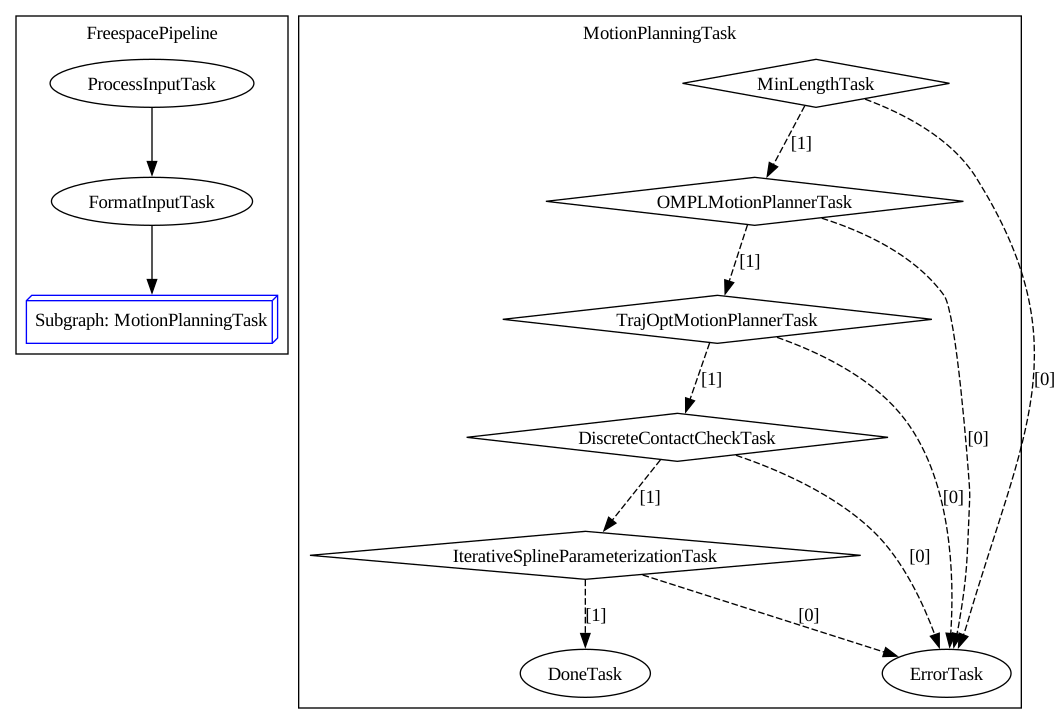
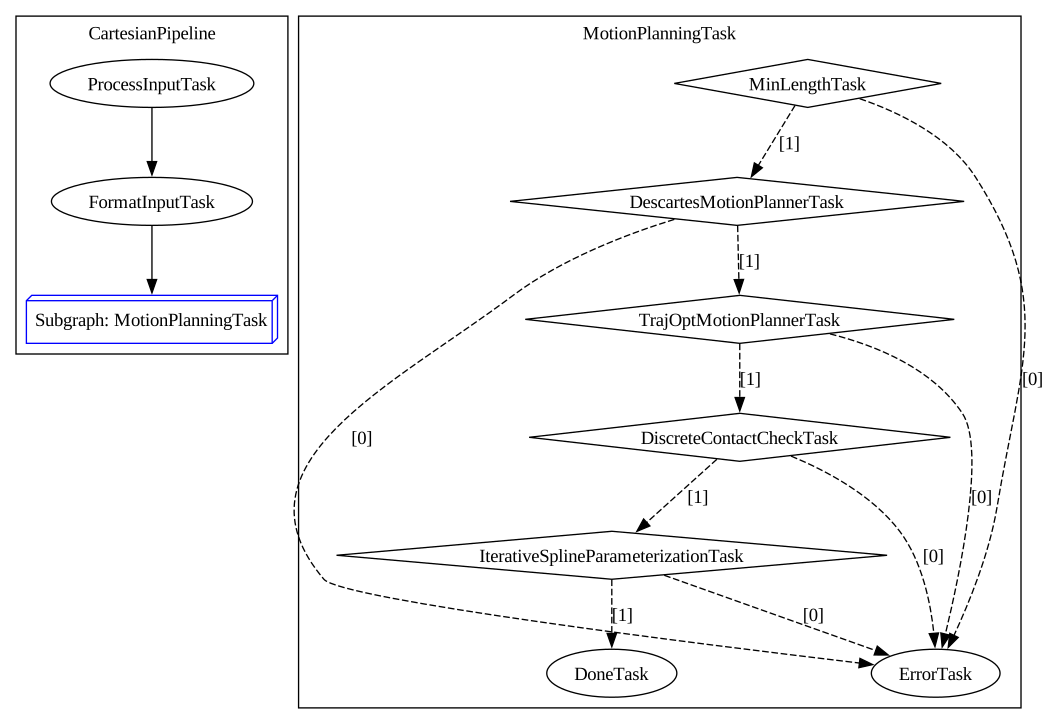
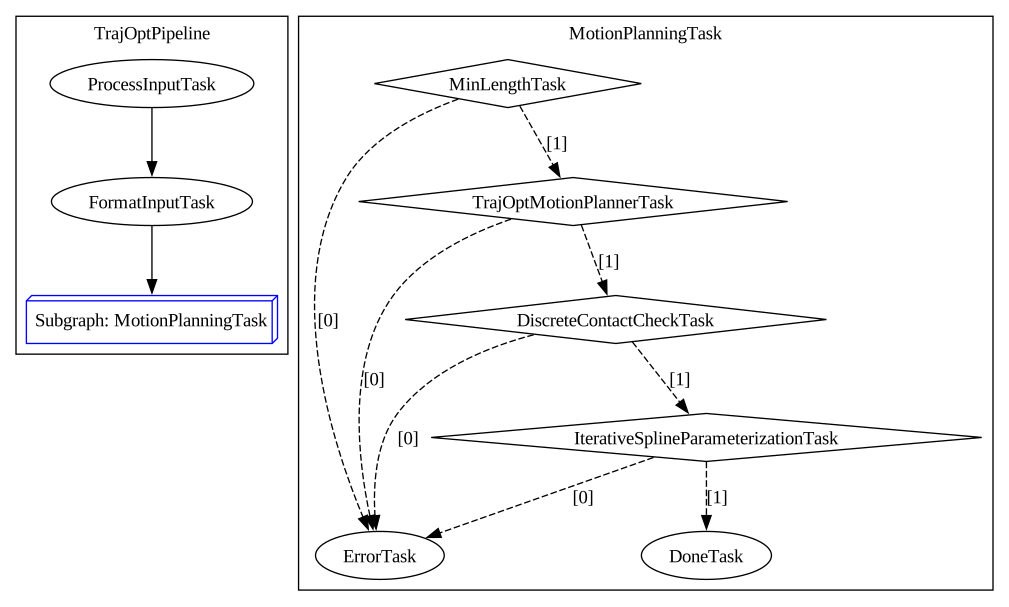
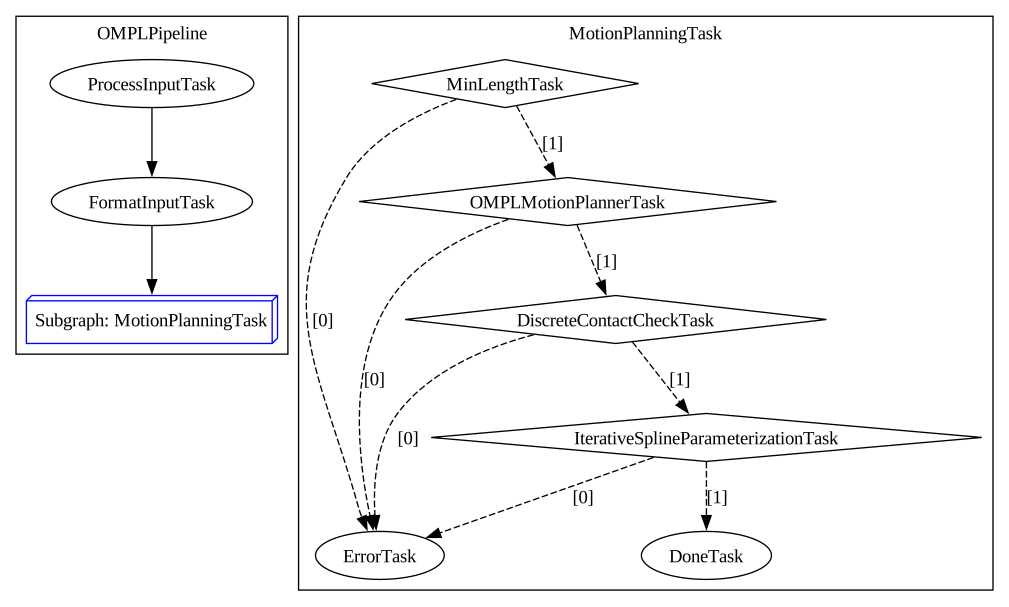
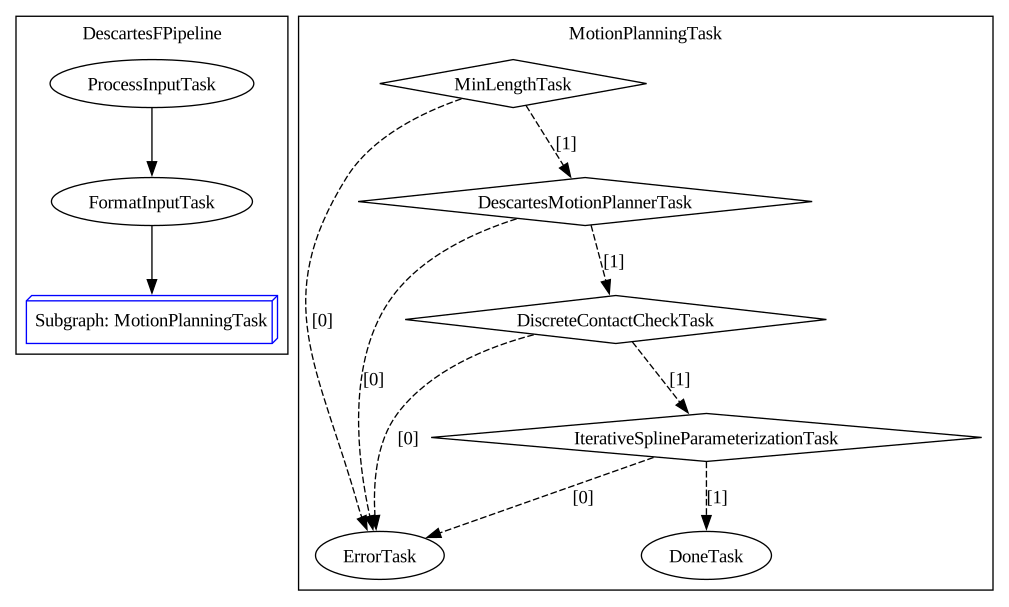
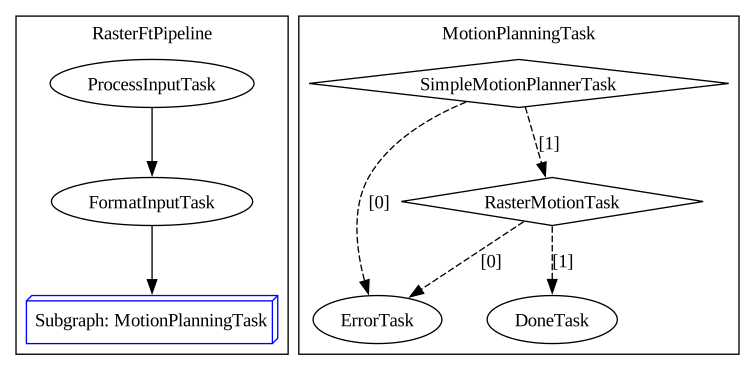
The graphs below are generated by scripts/generate_pipeline_dotgraphs.py (pixi run docs-dotgraphs), which trims dump()'s debug fields (UUIDs, C++ type names, I/O key maps) from the labels. Diamonds are conditional tasks; edge labels are the branch taken by their return value — [1] continues the pipeline, [0] jumps to ErrorTask. Subgraph nodes expand into their own clusters. Click any graph to zoom.
Debugging failed plans
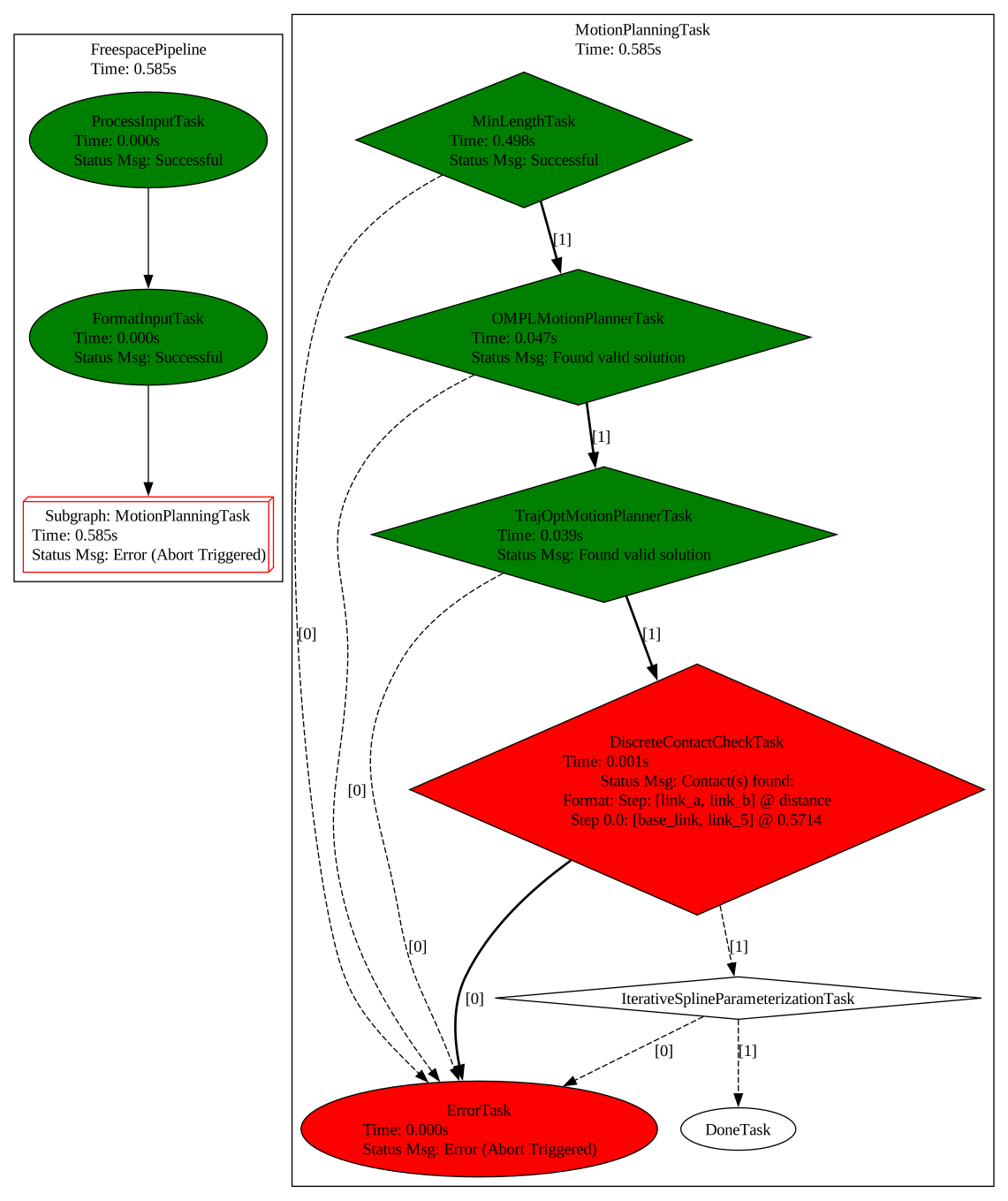
Both methods take an optional TaskComposerNodeInfoContainer — pass the run's task_infos to overlay execution results on the graph: successful nodes render green with their execution time, failed and aborted nodes render red.
future = composer.executor.run(task, task_data)
future.wait()

if not future.context.isSuccessful():
    # Annotated graph: green = succeeded (+ timing), red = failed/aborted
    task.saveDotgraph("debug.dot", future.context.task_infos)
This run was aborted by DiscreteContactCheckTask — the planners upstream succeeded (green, with solve times), the contact check failed (red, its status message naming the offending link pair), and the enclosing subgraph reports the abort:
First stop for a failed plan
result.message tells you that a plan failed; the annotated DOT graph
shows you where — including nodes that never ran because an earlier
stage aborted the pipeline.
Task Types
| Task | Purpose |
|---|---|
MinLengthTask |
Ensure a minimum number of waypoints |
OMPLMotionPlannerTask |
Sampling-based planning |
TrajOptMotionPlannerTask |
Trajectory optimization |
DescartesMotionPlannerTask |
Cartesian graph search |
SimpleMotionPlannerTask |
Joint interpolation |
TimeOptimalParameterizationTask |
Add time parametrization (TOTG) |
IterativeSplineParameterizationTask |
Smooth timing |
ContactCheckTask |
Collision validation |
FixStateBoundsTask |
Clamp to joint limits |
FixStateCollisionTask |
Push out of collision |
Profiles
Profiles configure each task's behaviour. TaskComposer.plan(...) auto-selects a pipeline-appropriate default set from planning/profiles.py. You can also build profiles yourself and pass them via the profiles keyword:
from tesseract_robotics.planning import create_trajopt_default_profiles

profiles = create_trajopt_default_profiles()
result = composer.plan(robot, program, pipeline="TrajOptPipeline", profiles=profiles)
For a manual ProfileDictionary:
from tesseract_robotics.tesseract_command_language import ProfileDictionary
from tesseract_robotics.tesseract_motion_planners_ompl import OMPLDefaultPlanProfile
from tesseract_robotics.tesseract_motion_planners_trajopt import (
    TrajOptDefaultPlanProfile,
)

profiles = ProfileDictionary()
profiles.addProfile("ompl",    "DEFAULT", OMPLDefaultPlanProfile())
profiles.addProfile("trajopt", "DEFAULT", TrajOptDefaultPlanProfile())
Error Handling
TaskComposer.plan(...) always returns a PlanningResult. On failure the result is populated from the task composer's aborting node info:
result = composer.plan(robot, program)
if not result.successful:
    print(f"Planning failed: {result.message}")
Common Failures
| Error | Cause | Solution |
|---|---|---|
OMPL failed to find solution |
Start/goal in collision or unreachable | Check collisions, increase time |
TrajOpt failed to converge |
Bad initial trajectory | Feed it an OMPL seed first |
Contact check failed |
Trajectory has collisions | Increase collision margin |
IK failed |
Cartesian target unreachable | Verify workspace + TCP offset |
createTaskComposerNode: 'X' not found among the configured plugins: […] |
pipeline= names no configured node |
Pick a name from the list in the message |
On the raw factory, createTaskComposerNode and createTaskComposerExecutor raise
TaskComposerPluginError (a RuntimeError) instead of returning None; plan turns it into
a failed PlanningResult.
Parallel Execution
The Task Composer uses Taskflow for parallel execution. Override the thread count via TaskComposer.from_config(num_threads=...) or pass a pre-built executor:
from tesseract_robotics.tesseract_task_composer import TaskflowTaskComposerExecutor

# Override YAML-configured thread count
composer = TaskComposer.from_config(num_threads=8)

# Or provide a custom executor
executor = TaskflowTaskComposerExecutor("MyExecutor", 8)
composer = TaskComposer.from_config(executor=executor)
Automatic Parallelization
Independent tasks (such as IK for different waypoints) run in parallel automatically. The task graph determines dependencies.
Custom Pipelines
Define custom task graphs in YAML and point TaskComposer.from_config(path) at them:
# custom_pipeline.yaml
task_composer_plugins:
  tasks:
    MyCustomPipeline:
      type: graph
      nodes:
        - name: plan_ompl
          type: OMPLMotionPlannerTask
          input: planning_input
          output: ompl_output

        - name: smooth_trajopt
          type: TrajOptMotionPlannerTask
          input: ompl_output
          output: trajopt_output
          depends: [plan_ompl]

        - name: time_param
          type: TimeOptimalParameterizationTask
          input: trajopt_output
          output: output_program
          depends: [smooth_trajopt]
Integration Example
Use a warmed-up composer behind a small service class:
from tesseract_robotics.planning import Robot, TaskComposer

class PlanningServer:
    def __init__(self, robot: Robot):
        self.robot = robot
        self.composer = TaskComposer.from_config()
        self.composer.warmup(["FreespacePipeline"])    # one-time cost

    def plan_motion(self, program):
        return self.composer.plan(
            self.robot, program, pipeline="FreespacePipeline"
        )
Next Steps
- Low-Level SQP — Real-time trajectory optimization
- Online Planning Example — Dynamic replanning