 |
Tesseract 0.28.4
|
|
Tesseract 0.28.4
|
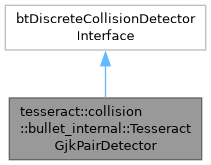
This is a modifed Convex to Convex collision algorithm. More...
#include <tesseract_gjk_pair_detector.h>
Public Member Functions | |
| TesseractGjkPairDetector (const btConvexShape *objectA, const btConvexShape *objectB, btSimplexSolverInterface *simplexSolver, btConvexPenetrationDepthSolver *penetrationDepthSolver, const ContactTestData *cdata) | |
| TesseractGjkPairDetector (const btConvexShape *objectA, const btConvexShape *objectB, int shapeTypeA, int shapeTypeB, btScalar marginA, btScalar marginB, btSimplexSolverInterface *simplexSolver, btConvexPenetrationDepthSolver *penetrationDepthSolver, const ContactTestData *cdata) | |
| void | getClosestPoints (const ClosestPointInput &input, Result &output, class btIDebugDraw *debugDraw, bool swapResults=false) override |
| void | getClosestPointsNonVirtual (const ClosestPointInput &input, Result &output, class btIDebugDraw *debugDraw) |
| void | setMinkowskiA (const btConvexShape *minkA) |
| void | setMinkowskiB (const btConvexShape *minkB) |
| void | setCachedSeparatingAxis (const btVector3 &separatingAxis) |
| const btVector3 & | getCachedSeparatingAxis () const |
| btScalar | getCachedSeparatingDistance () const |
| void | setPenetrationDepthSolver (btConvexPenetrationDepthSolver *penetrationDepthSolver) |
| void | setIgnoreMargin (bool ignoreMargin) |
| don't use setIgnoreMargin, it's for Bullet's internal use | |
Public Attributes | |
| int | m_lastUsedMethod |
| int | m_curIter { 0 } |
| int | m_degenerateSimplex { 0 } |
| int | m_catchDegeneracies |
| int | m_fixContactNormalDirection |
This is a modifed Convex to Convex collision algorithm.
This was modified to leverage the Tesseract contact request to enable and disable different parts of the algorithm. The algorithm first does a quick binary check if the two objects are in collision. If in collision it runs the penetration algorithm to get the nearest points and penetration depths. If not in collision it runs the an algorithm to get the nearest points and distance. The Tesseract contact request allow you to now decide if you need all three. Example, in the case of OMPL if you have a contact distance of zero you can get a performance increase, by disabling the penetration and distance calculation because they add no value.
Note: This will not be able to be removed.
| void tesseract::collision::bullet_internal::TesseractGjkPairDetector::getClosestPointsNonVirtual | ( | const ClosestPointInput & | input, |
| Result & | output, | ||
| class btIDebugDraw * | debugDraw ) |
this is another degenerate case, where the initial GJK calculation reports a degenerate case EPA reports no penetration, and the second GJK (using the supporting vector without margin) reports a valid positive distance. Use the results of the second GJK instead of failing. thanks to Jacob.Langford for the reproduction case http://code.google.com/p/bullet/issues/detail?id=250
todo: need to track down this EPA penetration solver degeneracy the penetration solver reports penetration but the contact normal connecting the contact points is pointing in the opposite direction until then, detect the issue and revert the normal
 1.15.0